
-
Welcome!
Register and log in easily with Twitter or Google accounts!
Or simply create a new Huddle account.
Members receive fewer ads , access our dark theme, and the ability to join the discussion!

-
-

-
-
Topics
-
-
-
-
Posts
-
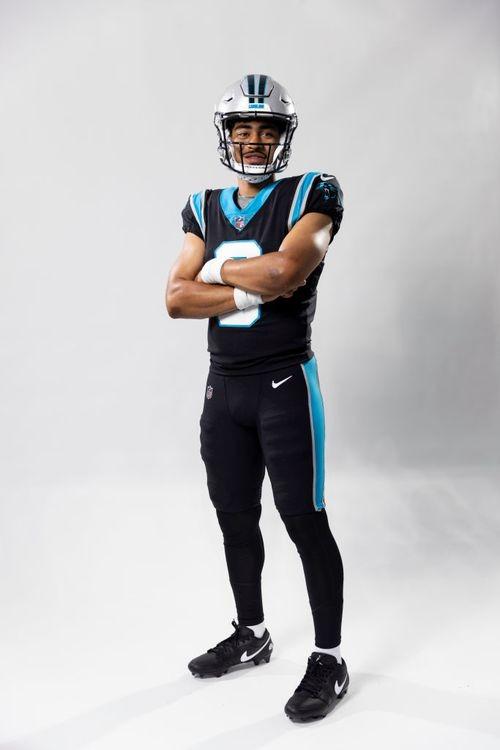
 In my view, the realistic expectation for this team to compete will start 2027. At that time, I think we could be looking at the following (this is HIGHLY speculative): QB: You know, Bryce. I am not a fan, but they don't ask me. But there is reason for hope--and here it is. Bryce will be entering his prime. Since we are likely to pay him, there will be changes that I include throughout this exercise--I realistically speculate on what they are going to do with Bryce and then I realistically speculate on what means in terms of the cap and other positions. Bryce HAS IMPROVED. The idea is that if you give him more weapons and protection, that will continue. His career: At this rate, if his growth continues, by 2027 we should expect nearly 30 TDs and about 12 Interceptions and a Rating of about 98. His completion percentage should settle at 65-66% or so. If that happens, you can win with it. The following stats demonstrate how the Panthers will be able to afford it (and re-sign Ickey) My guess is they will require about $60m per year. This is why rookies who can play are important. It also helps us see the blueprint. You may disagree, but this is the cruel realities of the salary cap. Robert Hunt: Cut post June 1 and save $19m. Who do you replace him with? Ickey. Tershawn Wharton: Cutting him saves nearly $15m. We should all hope to see Aaron Hall (UDFA) make the roster and play well. Regardless, this is a position we would likely have to address in the next draft. Trevin Moehrig: Cutting Moehrig as the starting SS saves this team $16.5m. Ransom will be on year 3 of a cheap rookie deal and should be more than ready to take the reins. their styles are similar. Furthermore, FS Wheatley (R, 4th round) will be starting. Taylor Moton: So much depends on his knee, but I have an idea that he can play another 3 years. extending him could save the team about $5m per year. Cutting him outright would save the team about $21m. In the most drastic situation, we have to cut Moton and the other three players mentioned. We would need (in all likelihood) a starting DT and RT. It is possible that the DE would be addressed, but Wharton's production (so far) could be equaled by a rookie. Look for a cut free agent and a 2027 draft pick here. If you cut Moton, you save $21m, and that would be the only big hole to fill. Having Ickey at RG gives you some depth at T, and Ickey could be the guy. T could be pick in the 2027 draft (first round), fwiw. It saves you $21m while costing you $5m, for example. We get younger, creating a core of Freeling, Hecht, and the RT first rounder in 2027) along with Ekownu (second contract in the $15m range, and Lewis, whose contract would be in the $16m range if not extended.) The OL cuts (Hunt, Moton) would save $40m. The OL would get younger and still solid with veterans at G. By cutting Wharton (no brainer if his play stays the same) and Moehrig (good player--but we have Ransom on a rookie contract who would not be that much of a drop off--if any) in addition to Hunt and Moton, we would save over $70m in cap room. We would be able to give Bryce bag and we would have enough to re-sign Ickey (if the knee is not too risky) to a Guard contract (probably at a discount, coming off that injury). Furthermore, we could add a RT in the draft (or a RG if Ickey moves to RT) and that would be the only large hole to fill. Correct my logic if you see issues-- On defense, in addition to the aforementioned, Scott ($2m contract) is out, replaced by a 4th round rookie contract. CB Jackson's contract ($7.8m) expires and he is (possibly) replaced by a rookie contract. At Edge, patrick Jones II's $10m contract expires and he is likely a reserve, and his role is absorbed by Phillips, Scourton, Princely, and possible an UDFA like Isaiah Smith or a 2027 draft pick. These productive developmental players over the past 2 drafts will pay huge dividends. On paper, I see the team getting much younger and possibly better while cutting nearly $100m and reallocating that money to get more production.
 -
 If everything played out and that last thing happened, I probably just quit.
 -
-
-

Recommended Posts
Archived
This topic is now archived and is closed to further replies.