
-
Welcome!
Register and log in easily with Twitter or Google accounts!
Or simply create a new Huddle account.
Members receive fewer ads , access our dark theme, and the ability to join the discussion!

-
-

-
-
Topics
-
-
-
-
Posts
-
 Exactly what I was going to say. Brady seems to be taking a page out of Olsen's playbook, which is probably a good thing. They'll probably get around to giving Brady an Emmy one day, and he should thank Olsen for giving him the blueprint for success.
 -
In before: "XL sucks, there is no hope." "As long as we have Bryce, none of this matters." My response: "It's X, not XL...we're not discussing apparel sizes, or we'd have to consider XS."
-
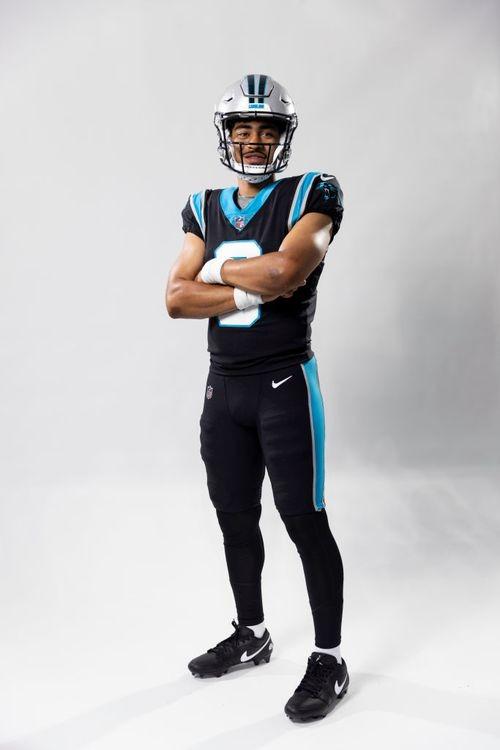
Alain Pierre provides some food for thought on Last Word On Sports regarding Xavier Legette, and his article, though specifically on X, kind of puts me in the mind of QBs being overdrafted and put into situations that they're not prepared for, some ultimately failing due to drafting missteps by front offices who don't necessarily view prospective players within the contextual importance that situations demand. At this point, Legette looks like a failure in reference to expectations, of not only what a consistently productive NFL receiver looks like, but a first round pick (which he obviously should never have been). But the story on X isn't necessarily completely over. Damn. I seem to be experiencing deja vu...It wasn't X's fault that he was overdrafted, that was a choice by an FO that obviously downplayed actual realized skill vs outstanding measurables and upside. Sure, the FO was impressed by X's one-year feats during his senior season at South Carolina, but it was the NFL god, RAS (a.k.a. Raw Athletic Score), that had Dave Canales's and Dan Morgan's jaws dropping in amazement at the sight of X running around in underwear at the Combine... "At 6-foot-3 and over 220 pounds, Legette brought rare athletic upside to the position. His breakout season at South Carolina showed flashes of dominance that NFL teams dream of. Projecting forward, many scouts compared his physical profile to D.K. Metcalf, and the Panthers clearly believed they could develop him into a true wide receiver 1 over time. The issue was never his talent. The issue was the timeline. Just a few picks later, the Chargers selected Ladd McConkey, a receiver who may have lacked Xavier Legette’s physical ceiling but entered the league far more technically refined. McConkey immediately showed advanced route discipline, leverage awareness, good pacing, and separation ability. Bryce Young’s game has always depended on timing and anticipation. His best football at Alabama came with receivers capable of winning through precision rather than pure athleticism. Jameson Williams and John Metchie III were excellent route runners and were able to get drafted in 2022. McConkey naturally fit that style of play. Legette, meanwhile, needed significant development in the exact areas where Bryce Young needed help. The Panthers drafted traits when Bryce Young needed reliability." Yes, the FO was guilty. The good thing is that the execs appear to be improving. Some of that may be attributed to the hiring of Eric Eager (who was hired right after the Xavier Legette draft). Eager seems to have helped the Panthers FO fine-tune their analytical progress, and, at least on paper, they acquired players with a lot of value during the last draft in regards to actually (what I'll refer to as) "underdrafting" talent relative to their position with value already built in. Look at Chris Brazzell: He may be more of the quintessential project receiver who was arguably more or less just as raw as Legette was when he was drafted, and with a relatively high RAS as well. The notable difference is value, as Brazzell was a round three pick and Legette was a first rounder. "Unlike the Xavier Legette situation, Carolina’s environment for Brazzell is completely different. "The Panthers are not asking a raw receiver prospect to stabilize this offense for Bryce Young. "Brazzell enters a much healthier developmental situation with far less pressure. With Tetairoa McMillan established as the primary target and Jalen Coker continuing to settle as the number 2 option...Xavier Legette, Metchie III, and Jimmy Horn Jr. are also still in this rotation, fighting for reps. "It gives Carolina something they failed to give Legette when they drafted him: A developmental runway. "Xavier Legette entered the league with expectations attached to a first-round pick and an offense desperate for answers. Brazzell enters a room where he can spend a year working on his route running, learning the playbook, and earning snaps gradually rather than being asked to become part of Bryce Young’s solution immediately. "And truthfully, Brazzell needs that time coming out of college. Despite his elite physical tools, many evaluators have several concerns about his overall polish as a receiver. "His route tree at Tennessee was viewed as fairly limited due to the type of offense that they run. The receivers are expected to run a lot of choice routes, which are dictated by the placement of the defenders. It doesn’t require technical route-running and an understanding of the playbook needed at the NFL level... "Context changes significantly when expectations change. "The Panthers are not depending on Brazzell to save the offense. They can allow him to develop slowly, expand his route tree, improve his technical refinement, and learn behind a much more stable receiver room... "Traits become much easier to bet on when patience is built into the plan." It's all about understanding your situation. I don't agree that it's an inherently difficult choice like the author is suggesting in the following excerpt. At the very least, I think that it should be easier as long as all parties involved stay levelheaded and true to their process. "That is what makes these draft decisions so difficult. "Every front office believes it can find the next Metcalf, Owens, or Marshall. Sometimes they do. More often, they are betting on a development path that may take years to complete. "The challenge is understanding what your offense needs right now. "If a team has patience, stability, and a quarterback capable of carrying the offense while a receiver develops, betting on traits can make sense. But if a young quarterback needs immediate help, there is a strong argument for prioritizing the receiver who already knows how to separate, create throwing , and earn trust from day one. "That’s why the Xavier Legette-Ladd McConkey debate remains so fascinating. "It was never really a discussion about talent. It was a discussion about timing." For me, Ladd McConkey was talented enough in his own right, that the gap--the upside--was never as big as people are suggesting between not only McConkey and Legette, but McConkey and other receivers drafted in the first round during that draft. The technique divide between Ladd and X was pretty stark though, as was the roughly 35 pounds, but the speed was identical, the maybe 1½ height difference isn't huge (6' and 6'1"), and it may surprise some that Ladd's RAS (9.34) was also enough to put him in the top 10 percent of receivers since 1987. There is an argument that he would've been a better pick for Bryce and the Panthers, regardless of timeline and talent. But, I still appreciate the thesis (if you will) of the article, as it still provides some hope--perhaps a glimmer at this point, that X's RAS may finally translate to the NFL given more time, but, perhaps more importantly, it explains how Dan Morgan and company are showing improvement, even if it appears somewhat understated. My hope is that continued improvement is palpable by this time next year. https://lastwordonsports.com/nfl/2026/05/30/xavier-legette-draft-lessons/#google_vignette
-
-


Recommended Posts
Archived
This topic is now archived and is closed to further replies.