Jump to content
  • Welcome!

    Register and log in easily with Twitter or Google accounts!

    Or simply create a new Huddle account. 

    Members receive fewer ads , access our dark theme, and the ability to join the discussion!


More muscle, more problems: How one metric could change NFL training


ladypanther
 Share

Recommended Posts

https://www.washingtonpost.com/sports/2023/04/26/nfl-draft-training/

 Holway was working as a personal trainer when he attended a lecture on an obscure topic in his field: muscle-to-bone ratio, or MBR, which quantifies how much muscle mass a skeleton is carrying. To Holway, it sounded like a revelation. 

 He realized the skeleton was the human chassis, and muscle mass — not body-fat percentage, the focus of many dietitians and their clients — would drive performance. MBR helps athletes determine their optimal muscle mass so they can reduce injury risk and reach their peak physiques.

After the lecture, Holway learned how to calculate MBR. He used specialized tools to measure his clients — logging femur length, pelvic width and other metrics — then plugged 20-plus variables into an equation. His earliest measurements produced the same results he would replicate over the next two decades in thousands of elite athletes across many sports, including judo, soccer, weightlifting and boxing: In men, each pound of bone can support a maximum of about five pounds of muscle. In women, it’s slightly less.

Basically, the body hits that five-to-one ratio, and after that it only adds fat, not muscle. Bigger doesn’t always mean better.

....... has helped spread belief in MBR to the unlikeliest of places: the NFL, where it could revolutionize player production, injury-risk mitigation and talent identification.

.... they measured hundreds of football players around the country and made several discoveries. White players’ average maximum MBR (5.5) was lower than Black players’ (5.9). Typically, defensive linemen had the highest MBR (5.5) and wide receivers the lowest (4.9).

One of their most important findings was that maximal didn’t necessarily mean optimal. Players with higher MBRs than their position’s normative range seemed to struggle more with soft-tissue injuries. “Nine times out of 10,” Wellman said, when he encounters a wide receiver with an MBR of 5.1 or higher, coaches tell him stories about how the player battled such injuries.

“Guys that are 4.8, 4.9, there’s not as many stories,” he said. He paused. “I’m not ready to sit here in front of you and say, ‘Yes, when you get to this ratio, you’re going to be injured.’ I don’t know if we’ll ever say that. But I will say there’s too many anecdotes to ignore. And if we ignore this, I think we’re making a mistake.”

Though there will always be intangibles in talent evaluation — character, intelligence, attitude, work ethic, football IQ — MBR could provide valuable insight about the body underpinning the player’s performance. For medical and strength staff, MBR could revolutionize training programs and injury-risk mitigation. For general managers, it could revolutionize the talent evaluation process.

If a GM is scouting a dozen 6-foot-6 offensive tackles, MBR would tell him who could gain muscle and who is already maxed out, only able to add fat, which sometimes can help linemen but most often degrades performance. For cornerbacks, a GM might look at shoulder-to-hip ratio, which strongly relates to how fast a player can rotate his hips.

Further study could shed light on some pressing questions. What percentage of NFL players are significantly above their position’s MBR normative range? If all of those players went down to a normal MBR, would the rate of soft-tissue injuries plummet? If they did, and the league got healthier — and perhaps even smaller — could a prospect’s skeleton become as important to his draft stock as his results at the combine?

So far, Wellman said, about eight NFL teams have tried using MBR. In the coming months, Holway plans to meet with at least two more. In a league with players who have been growing larger for decades, how will a philosophy that sometimes contradicts that trend fit?

It’s too early to tell. But if MBR is as big as Callaway and Wellman believe it to be, and if Holway’s methods continue to produce discoveries, then in a league with unparalleled parity, it could provide a winning edge.

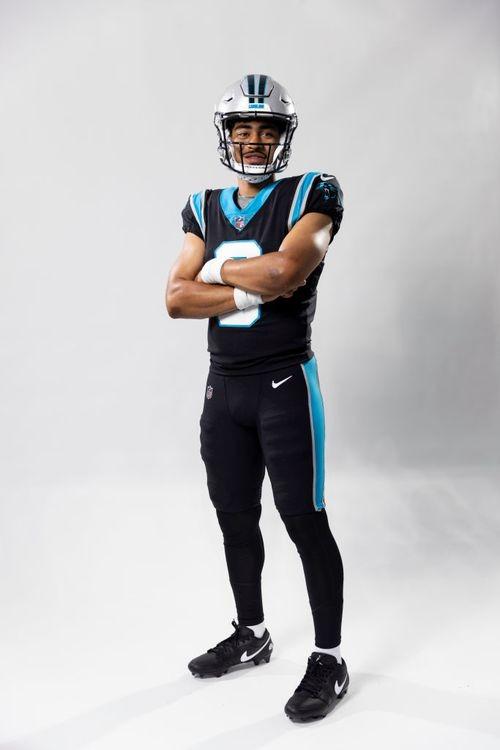
Hope the Panthers are on board...especially as they try to add to the frame of the likely new QB.

  • Pie 8
  • Beer 1
Link to comment
Share on other sites

i'm curious what kind of injuries they are thinking could be happening. i mean i do have my suspicions and it largely has to do with what we saw in CMC. he stayed healthy for most of his career, but then he started trying to bulk up because one of the knocks against him coming into the league was this belief that he was too small and not strong enough to run between the tackles. 

then every year we see him jacked up much more than he was the previous year, but then he also kept getting non-contact injuries that would sideline him for much of the seasons. 

i don't think that the two are unrelated. i think it was more power than his frame could safely handle.

  • Pie 8
Link to comment
Share on other sites

15 minutes ago, ladypanther said:

https://www.washingtonpost.com/sports/2023/04/26/nfl-draft-training/

 Holway was working as a personal trainer when he attended a lecture on an obscure topic in his field: muscle-to-bone ratio, or MBR, which quantifies how much muscle mass a skeleton is carrying. To Holway, it sounded like a revelation. 

 He realized the skeleton was the human chassis, and muscle mass — not body-fat percentage, the focus of many dietitians and their clients — would drive performance. MBR helps athletes determine their optimal muscle mass so they can reduce injury risk and reach their peak physiques.

After the lecture, Holway learned how to calculate MBR. He used specialized tools to measure his clients — logging femur length, pelvic width and other metrics — then plugged 20-plus variables into an equation. His earliest measurements produced the same results he would replicate over the next two decades in thousands of elite athletes across many sports, including judo, soccer, weightlifting and boxing: In men, each pound of bone can support a maximum of about five pounds of muscle. In women, it’s slightly less.

Basically, the body hits that five-to-one ratio, and after that it only adds fat, not muscle. Bigger doesn’t always mean better.

....... has helped spread belief in MBR to the unlikeliest of places: the NFL, where it could revolutionize player production, injury-risk mitigation and talent identification.

.... they measured hundreds of football players around the country and made several discoveries. White players’ average maximum MBR (5.5) was lower than Black players’ (5.9). Typically, defensive linemen had the highest MBR (5.5) and wide receivers the lowest (4.9).

One of their most important findings was that maximal didn’t necessarily mean optimal. Players with higher MBRs than their position’s normative range seemed to struggle more with soft-tissue injuries. “Nine times out of 10,” Wellman said, when he encounters a wide receiver with an MBR of 5.1 or higher, coaches tell him stories about how the player battled such injuries.

“Guys that are 4.8, 4.9, there’s not as many stories,” he said. He paused. “I’m not ready to sit here in front of you and say, ‘Yes, when you get to this ratio, you’re going to be injured.’ I don’t know if we’ll ever say that. But I will say there’s too many anecdotes to ignore. And if we ignore this, I think we’re making a mistake.”

Though there will always be intangibles in talent evaluation — character, intelligence, attitude, work ethic, football IQ — MBR could provide valuable insight about the body underpinning the player’s performance. For medical and strength staff, MBR could revolutionize training programs and injury-risk mitigation. For general managers, it could revolutionize the talent evaluation process.

If a GM is scouting a dozen 6-foot-6 offensive tackles, MBR would tell him who could gain muscle and who is already maxed out, only able to add fat, which sometimes can help linemen but most often degrades performance. For cornerbacks, a GM might look at shoulder-to-hip ratio, which strongly relates to how fast a player can rotate his hips.

Further study could shed light on some pressing questions. What percentage of NFL players are significantly above their position’s MBR normative range? If all of those players went down to a normal MBR, would the rate of soft-tissue injuries plummet? If they did, and the league got healthier — and perhaps even smaller — could a prospect’s skeleton become as important to his draft stock as his results at the combine?

So far, Wellman said, about eight NFL teams have tried using MBR. In the coming months, Holway plans to meet with at least two more. In a league with players who have been growing larger for decades, how will a philosophy that sometimes contradicts that trend fit?

It’s too early to tell. But if MBR is as big as Callaway and Wellman believe it to be, and if Holway’s methods continue to produce discoveries, then in a league with unparalleled parity, it could provide a winning edge.

Hope the Panthers are on board...especially as they try to add to the frame of the likely new QB.

Unfortunately I read in an article some where that one NFL GM said bryce Yound has a "frail" frame.  I don't know if that was just sour grapes talking or what, but I guess we are about to find out. If Young is the pick I am hoping for the best but, we should remember that Young is shorter than Armanti Edwards was at draft time and about the same weight.

Link to comment
Share on other sites

Just now, rayzor said:

then every year we see him jacked up much more than he was the previous year, but then he also kept getting non-contact injuries that would sideline him for much of the seasons. 

I actually think he was less jacked last year than the previous year when we saw him more ripped than ever and likely contributed to his soft tissue injuries 

  • Pie 2
Link to comment
Share on other sites

("Basically, the body hits that five-to-one ratio, and after that it only adds fat, not muscle. Bigger doesn’t always mean better.")

If this is factual, then the NFL, as well as all the teams, need to get on board and  do their own research pertaining to MBR for both safety  and performance reasons.

Link to comment
Share on other sites

19 minutes ago, rayzor said:

i'm curious what kind of injuries they are thinking could be happening. i mean i do have my suspicions and it largely has to do with what we saw in CMC. he stayed healthy for most of his career, but then he started trying to bulk up because one of the knocks against him coming into the league was this belief that he was too small and not strong enough to run between the tackles. 

then every year we see him jacked up much more than he was the previous year, but then he also kept getting non-contact injuries that would sideline him for much of the seasons. 

i don't think that the two are unrelated. i think it was more power than his frame could safely handle.

This is the first thing that popped into my mind as I was reading this.

Link to comment
Share on other sites

This is very interesting and it makes sense. However, Im not sure I agree that at a point the body can only add fat and not muscle. Look at bodybuilders that add huge amounts of muscle to what is sometimes a small frame.

But it makes sense from the weight standpoint as well as stresses that a player is applying to bones, joints and ligaments. Keeping below that ratio keeps the muscle as the weak point. Overbuilding the muscle makes the ligaments, joints and maybe even bones the weak point.

Link to comment
Share on other sites

1 hour ago, rayzor said:

i'm curious what kind of injuries they are thinking could be happening. i mean i do have my suspicions and it largely has to do with what we saw in CMC. he stayed healthy for most of his career, but then he started trying to bulk up because one of the knocks against him coming into the league was this belief that he was too small and not strong enough to run between the tackles. 

then every year we see him jacked up much more than he was the previous year, but then he also kept getting non-contact injuries that would sideline him for much of the seasons. 

i don't think that the two are unrelated. i think it was more power than his frame could safely handle.

along with the fact that our coaching staff would run 20 hb dives up the gut per game and then have his legs fall off by week 3

  • Pie 1
Link to comment
Share on other sites

1 hour ago, bigpoppa said:

This is very interesting and it makes sense. However, Im not sure I agree that at a point the body can only add fat and not muscle. Look at bodybuilders that add huge amounts of muscle to what is sometimes a small frame.

But it makes sense from the weight standpoint as well as stresses that a player is applying to bones, joints and ligaments. Keeping below that ratio keeps the muscle as the weak point. Overbuilding the muscle makes the ligaments, joints and maybe even bones the weak point.

There has been a lot of research and they continue to do more.  I only quoted a few highlights.  Long article.

.....“I’ve got more [MBR] data on American football than anyone else on planet Earth,” he said, and that has forced him to reconsider one of the most fundamental principles of the field to which he has dedicated his life. “Five years ago, as a strength coach, I would’ve told you that as long as you’re gaining muscle mass, performance will increase. I don’t believe that anymore.”

....

Holway measured all of the Exos prospects. Several had MBRs above 5.7, including a linebacker at 6.1. They had so much muscle on their skeletons that, Callaway said, it was as if they had put a 700-horsepower engine in a Ford Fiesta.

“You watch them move, and you’re like, ‘They should be faster than that,’ ” Callaway said. “But the body doesn’t want all of the horsepower that the muscle can produce.”

Callaway told a few prospects they had too much muscle on their frames; they could be unknowingly compensating for it and increasing their risk of injury. Many believed him because they felt sluggish at such heavy weights. But at the same time, it felt wrong to want to be smaller.

....

The advent of MBR also has led Callaway to think differently about players he has trained who looked like superheroes but couldn’t perform like them.

“[One year, a player’s] agent was always on me, like: ‘Why isn’t he faster? Look at him,’ ” Callaway said. “And I’m like: ‘I know. I’m doing the same thing with him that I’m doing with everybody else, and he’s not making the same improvements that everybody else is.’ But I guarantee you, if we went back and measured [him], he would have a small skeleton.”


Link to comment
Share on other sites

Join the conversation

You can post now and register later. If you have an account, sign in now to post with your account.

Guest
Reply to this topic...

×   Pasted as rich text.   Paste as plain text instead

  Only 75 emoji are allowed.

×   Your link has been automatically embedded.   Display as a link instead

×   Your previous content has been restored.   Clear editor

×   You cannot paste images directly. Upload or insert images from URL.

 Share


  • PMH4OWPW7JD2TDGWZKTOYL2T3E.jpg

  • Topics

  • Posts

    • It all sounds great. The only unknowns are injuries and how they will need to be addressed. Horn has a history as does the newly added Jaelen Phillips and Cooker has yet to play an entire season as well. And then there are the Ikey's - totally unexpecteded injuries that put a major wrench in your plans. I do think its a great plan though.
    • If we pay Bryce like a franchise QB we're completely and utterly buttfuged.
    • In my view, the realistic expectation for this team to compete will start 2027.  At that time, I think we could be looking at the following (this is HIGHLY speculative):   QB:  You know, Bryce.  I am not a fan, but they don't ask me.  But there is reason for hope--and here it is.  Bryce will be entering his prime.  Since we are likely to pay him, there will be changes that I include throughout this exercise--I realistically speculate on what they are going to do with Bryce and then I realistically speculate on what means in terms of the cap and other positions. Bryce HAS IMPROVED.  The idea is that if you give him more weapons and protection, that will continue.  His career:   At this rate, if his growth continues, by 2027 we should expect nearly 30 TDs and about 12 Interceptions and a Rating of about 98.  His completion percentage should settle at 65-66% or so.  If that happens, you can win with it. The following stats demonstrate how the Panthers will be able to afford it (and re-sign Ickey) My guess is they will require about $60m per year. This is why rookies who can play are important.  It also helps us see the blueprint.  You may disagree, but this is the cruel realities of the salary cap. Robert Hunt:  Cut post June 1 and save $19m.  Who do you replace him with?  Ickey. Tershawn Wharton:  Cutting him saves nearly $15m.  We should all hope to see Aaron Hall (UDFA) make the roster and play well.  Regardless, this is a position we would likely have to address in the next draft. Trevin Moehrig:  Cutting Moehrig as the starting SS saves this team $16.5m.   Ransom will be on year 3 of a cheap rookie deal and should be more than ready to take the reins.  their styles are similar.  Furthermore, FS Wheatley (R, 4th round) will be starting. Taylor Moton:  So much depends on his knee, but I have an idea that he can play another 3 years.  extending him could save the team about $5m per year.  Cutting him outright would save the team about $21m. In the most drastic situation, we have to cut Moton and the other three players mentioned.   We would need (in all likelihood) a starting DT and RT.  It is possible that the DE would be addressed, but Wharton's production (so far) could be equaled by a rookie.  Look for a cut free agent and a 2027 draft pick here.  If you cut Moton, you save $21m, and that would be the only big hole to fill.  Having Ickey at RG gives you some depth at T, and Ickey could be the guy.  T could be pick in the 2027 draft (first round), fwiw.  It saves you $21m while costing you $5m, for example. We get younger, creating a core of Freeling, Hecht, and the RT first rounder in 2027) along with Ekownu (second contract in the $15m range, and Lewis, whose contract would be in the $16m range if not extended.)  The OL cuts (Hunt, Moton) would save $40m.  The OL would get younger and still solid with veterans at G.   By cutting Wharton (no brainer if his play stays the same) and Moehrig (good player--but we have Ransom on a rookie contract who would not be that much of a drop off--if any) in addition to Hunt and Moton, we would save over $70m in cap room. We would be able to give Bryce bag  and we would have enough to re-sign Ickey (if the knee is not too risky) to a Guard contract (probably at a discount, coming off that injury).  Furthermore, we could add a RT in the draft (or a RG if Ickey moves to RT) and that would be the only large hole to fill. Correct my logic if you see issues-- On defense, in addition to the aforementioned, Scott ($2m contract) is out, replaced by a 4th round rookie contract. CB Jackson's contract ($7.8m) expires and he is (possibly) replaced by a rookie contract.  At Edge, patrick Jones II's $10m contract expires and he is likely a reserve, and his role is absorbed by Phillips, Scourton, Princely, and possible an UDFA like Isaiah Smith or a 2027 draft pick.   These productive developmental players over the past 2 drafts will pay huge dividends.  On paper, I see the team getting much younger and possibly better while cutting nearly $100m and reallocating that money to get more production.          
×
×
  • Create New...